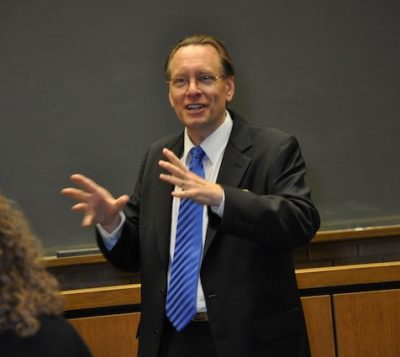
Sep 15, 2025 Mila SohoniAdministrative Law
Looming over our law, or lurking beneath it, are theoretical frameworks that guide how we think about it. With respect to administrative law, there are two such influential frameworks that will immediately spring to mind and that share much in common: originalism and cost-benefit analysis.
What? Readers might already be scratching their heads. This strange pairing would seem to be worlds apart. Originalism is the stuff of lofty theory and founding-era history and hard-fought debates concerning the nature of fundamental rights and the separation of powers. Cost-benefit analysis, in contrast, is the stuff of pocket protectors and green eyeshades and hard-fought debates concerning discount rates and valuations. Originalism is for lawyers; cost-benefit analysis is for economists. But as Professors Jonathan Masur and Eric Posner demonstrate in a recent article, The Common Political Foundations of Originalism and Cost-Benefit Analysis, the two have more kinship than meets the eye. Continue reading "Twins Separated at Birth"
Sep 12, 2025 Maartje van der WoudeCriminal Law
Legal scholars in the United States may be tempted to see the British immigration system as distant or parochial, marked by its own bureaucratic idiosyncrasies and Commonwealth-era legacies. But Mary Bosworth’s Supply Chain Justice makes clear that this is a mistake. This searing ethnographic analysis of immigration detention in the United Kingdom reveals not just a national policy architecture, but a global paradigm of border enforcement—one that resonates powerfully with ongoing developments in the United States.
At its heart, Supply Chain Justice is a meditation on outsourced state power: what happens when liberal democracies turn over core functions—especially the coercive task of incarceration—to private corporations, acting under performance-based contracts with limited oversight and diffuse responsibility. Bosworth uses the concept of the “supply chain” to describe the web of public and private actors—guards, managers, administrators, NGOs, civil servants—who collectively operate the UK’s immigration detention system. Continue reading "Outsourcing the Border, Outsourcing Justice"
Sep 11, 2025 Maureen CarrollCourts Law
Daniel Wilf-Townsend,
Deterring Unenforceable Terms, 111
Va. L. Rev. __ (forthcoming 2025), available at
SSRN (June 6, 2024).
Most of us (if not all) have entered a contract with one or more terms that a court would not enforce. From non-compete agreements in states that prohibit them, to leases that purport to limit the implied warranty of habitability, to waivers that disclaim liability for injuries resulting from the drafting party’s negligence, contracts containing clearly unenforceable terms have become ubiquitous. The usual remedy (such as it is) for the inclusion of such a term is for a court to decline to enforce it.
That remedy, Daniel Wilf-Townsend argues, is woefully inadequate. In Deterring Unenforceable Terms, he proposes to supplement it with “a general, affirmative prohibition on clearly unenforceable terms in contracts offered by a sophisticated drafter to large numbers of unsophisticated counterparties.” That proposal might seem bold, but over the course of the article, it starts to appear quite restrained. Continue reading "Should drafters be penalized for clearly unenforceable terms?"
Sep 10, 2025 Tom C.W. LinCorporate Law
Sergio Alberto Gramitto Ricci, Daniel J.H. Greenwood, & Christina M. Sautter,
The Shareholder Democracy Lie, 78
Fla. L. Rev. __ (forthcoming 2026), available at
SSRN (Feb. 18, 2025).
Governance is hard; democratic self-governance is even harder. The governance of our political institutions and corporations is replete with evidence of such difficulties. Yet, the alternatives to democratic self-governance, while administratively easier, are filled with their own dangers. As such, appeals to democracy and conceptions of democracy have long been used in law, business, and politics throughout history to justify policies and actions of varying democratic ends.
In The Shareholder Democracy Lie, Professors Sergio Gramitto Ricci, Daniel Greenwood, and Christina Sautter offer a deeply researched and rigorously reasoned critique of one of corporate law’s most enduring metaphors and misleading myths: shareholder democracy. The authors argue that the noble rhetoric of shareholder democracy does not reflect legal, institutional, and historical realities—and that this rhetorical distortion carries real consequences for corporate governance, political legitimacy, and social progress. Continue reading "The Shareholder Democracy Promise"
Sep 9, 2025 Omri Ben-ShaharContracts
- Haggai Porat, Behavior-Based Price Discrimination and Data Protection in the Age of Algorithms, available at SSRN (Oct. 31, 2022).
- Haggai Porat, Bargaining with Algorithms: An Experiment on Algorithmic Price Discrimination and Consumer and Data Protection Laws, available at SSRN (Apr. 29, 2025).
A central interest in consumer law is the harm AI algorithms might cause to consumers. Firms are increasingly gaining the power to target individual consumers in manipulative ways and charge prices tailored to each buyer’s ability to pay. People may end up buying things they do not need or regret, at prices exceeding those in the pre-algorithmic market. Rivers of academic ink are spilled in describing the potential harms and recommending urgent regulatory action. Some of that work is very good, although the entire genre is suffering from an acute oversight: it ignores the documented benefits pricing algorithms are bringing to consumers. Personalized prices have been repeatedly shown in the empirical economic literature to benefit low-income consumers (and why not? The easiest thing for these algorithms to infer is individual purchasing power, calibrating the price to match it).
An assumption that runs through much of the legal literature on pricing algorithms is the passivity of consumers. Short of anonymizing themselves by changing the privacy settings (and good luck with that), there is nothing consumers can do to blur their profiling by sellers’ algorithms. Consumers, in other words, are price-takers, and are said to be in peril. Continue reading "Can Consumers Roar Back?"
Sep 8, 2025 Lyrissa B. LidskyConstitutional Law
In the face of mass digital data harvesting and manipulation, the need for effective data privacy protection is imperative. In Data as Likeness, Professor Zahra Takhshid offers new legal tools to address this need by urging us to reconceptualize one of the common law privacy torts, namely, the tort of appropriation of name or likeness. Her contribution, however, is not limited to reconceptualizing the appropriation tort. She also offers valuable insights into how to secure Article III standing for data privacy harms.
Takhshid’s reconceptualization is built on the insight that “[o]ur digital persona or likeness is our personal data.” Thus, appropriation of our data is an appropriation of our likeness, worthy of compensation through tort law. Takhshid’s reconceptualization turns the appropriation tort into a means to hold Big Tech and others accountable for their ubiquitous collection and transmission of personally identifiable data, which, according to Takhshid, constitute wrongful exploitation of the individual. This approach would also treat deepfake creation, geolocation data collection, and the deployment of facial-recognition technology as exploitations of digital persona. Continue reading "Are You the Sum of Your Data? Appropriation of Digital Persona as Appropriation of Likeness"
Sep 5, 2025 Michael C. DuffWork Law
Alvin Velazquez,
The Death of Labor Law and the Rebirth of the Labor Movement, B.C.L. Rev. (forthcoming), available at
SSRN (Feb. 13, 2025).
In The Death of Labor Law, Professor Alvin Velazquez asks: what if the National Labor Relations Act (NLRA) dies because, as some employers want, the US Supreme Court declares – at this very late hour – that Act unconstitutional? (P. 18.). Assuming that happens, Velazquez offers “a silver lining” by showing how, by doing so, “the Court could serve as a catalyst for a series of (most likely) unfortunate events as well as fervent organizing opportunities.” (P. 7.) Thus, from death comes life. The article falls within a tradition of labor law scholarship that insists (like Oliver Wendall Holmes’ dissent in Vegelahn v. Guntner) that labor conflict is inevitable and labor law is always a provisional accommodation between labor and capital.
In particular, Velazquez considers how the NLRA might collapse (Pp. 13-25); reminds readers that labor law and labor conflict preexisted the NLRA (Pp. 49-50); takes solace in the Norris-LaGuardia Act’s bar on federal courts issuing labor injunctions in peaceful private-sector labor disputes (P. 38); and reminds readers that a defunct NLRA may mean a dissolution of unduly complex federal preemption doctrines, in turn freeing states to innovate in the area of labor relations in ways they cannot do now. (Pp. 31-38.) The article covers a great deal of ground. It will stimulate and provoke labor law readers and perhaps also general legal readers focused on major administrative law developments. Continue reading "Beyond Collapse: Why Labor Law Probably Can’t End"
Sep 4, 2025 Gerry W. BeyerTrusts & Estates
What if death was not the end? The rapid rise and advancement of generative artificial intelligence presents the unique opportunity to allow people to speak to loved ones who have passed. Samuel Hoy Brown VII’s Don’t Fear the Reaper? delves into the rapidly growing industry of posthumous communication, an increasingly lucrative industry. This article analyzes the intersection between artificial intelligence, mourning the loss of a loved one, after-death rights, and the law. As Brown explores the ethical effects of posthumous communication through artificial intelligence, he questions consent and the ownership of an individual’s likeness after death.
This article provides a comprehensive examination of the history of artificial intelligence, starting with early chatbot models like ELIZA to today’s highly specialized generative AI tools like HereAfter AI and You. Brown explains how these new specialized AI tools emerged, and how they are capitalizing on the posthumous communication market, promising families who are in mourning an opportunity to participate in “real” conversations with their loved ones. This AI technology uses voice recordings, texts, email communications, letters, and personal stories of the deceased to manufacture conversations for the families to have while they are grieving, and for family members and friends to enjoy for years to come. Some may see this tool as a comfort in the mourning process and as a method of preserving family history, while others may discern the ethical issues that can stem from this technology. Continue reading "The Double-Edged Sword of Digital Immortality"
Sep 3, 2025 Margot KaminskiTechnology Law
- Daniel Wilf-Townsend, The Deletion Remedy, 103 N. Car. L. Rev. __ (forthcoming 2025), available at SSRN (Sept. 20, 2024).
- Christina Lee, Beyond Algorithmic Disgorgement: Remedying Algorithmic Harms, 16 U.C. Irvine L. Rev. ___ (forthcoming 2026), available at SSRN (Apr. 10, 2025).
In 2019 the Federal Trade Commission (FTC) created a new remedy in data privacy and AI law: algorithmic disgorgement, also known as model deletion. The FTC required that Cambridge Analytica “delete all Covered Information collected from consumers… and any information or work product, including any algorithms or equations, that originated, in whole or in part, from this Covered Information.” The idea behind model deletion is that companies should not be able to profit of models trained on wrongfully obtained personal data.
Algorithmic disgorgement has by now received its fair share of praise, including from FTC Commissioner Rebecca Kelly Slaughter, who called it “an innovative and promising remedy.” The remedy’s boosters, however, have largely lauded how algorithmic disgorgement/model deletion can mitigate data privacy and algorithmic governance laws’ struggles to identify, quantify, and deter legally cognizable harms. Continue reading "AI Disgorgement or AI Recalls: A Trip down Remedy Lane"
Sep 2, 2025 Ellen BublickTorts
In the age of artificial intelligence (and statistics before that), there is a great need for these frameworks’ constant companion – data. After centuries of common law tort actions, and millions of lawsuits filed, one might think that much would be known about these suits. Not so. As James Anderson and co-authors from the Rand Institute for Civil Justice write, “Remarkably, there is little recent empirical research in the United States that measures the extent and sources of compensation, benefits, and assistance that individuals may receive after they suffer personal harms.” (Pp. 97-98.) Tort law counts among these empirically-neglected sources.
Anderson and the current RAND crew set out to fill this information gap. In tribute to Stanford Law School Professor Deborah Hensler and her pioneering empirical work on civil justice claims, the authors surveyed 17,000+ adult Americans about injuries, illness, and the ways in which losses from these difficulties were addressed. Using a standard that measured respondents’ lost days of work, inability to perform regular activities, multiple visits to a healthcare provider, nights in the hospital and visits to the emergency room, the researchers winnowed the group down to roughly 3,000 people who had suffered “significant injury or illness” under the study criteria in 2017. (P. 98.) Those 3000 people were asked to provide detailed information about the extent and manner of their injuries or illness; the harms, treatments, and expenses they endured; the sources of compensation they relied on; their views about attribution of blame; and their decisions to consult a lawyer, initiate suit, and pursue a claim. About two years after these first inquiries, the researchers sent follow up questions to learn more. Continue reading "When Do Injured People Sue? New Empirical Research on Blaming and Claiming in Tort Law"