Sep 7, 2020 Robert HillmanContracts
Shmuel I. Becher & Sarah Dadush,
Relationship as Product: Transacting in the Age of Loneliness, __
U. Ill. L. Rev. __ (forthcoming, 2021), available at
SSRN.
Articles on contract law contribute to our understanding of the subject in many different ways. Professors Becher and Dadush’s article, Relationship as Product: Transacting in the Age of Loneliness is a must read, not because it resolves a legal issue or presents a novel way of looking at a problem, but because it raises a red flag about business practices with consumers that requires attention. Becher and Dadush argue that businesses have new methods of taking advantage of consumers in contracts brought about in part by technological advances and the concomitant social isolation and loneliness of people in our 21st century society. The authors write that “[B]usinesses increasingly utilize big data, sophisticated technology, and psychological vulnerabilities to design and tailor highly personalized and emotionally charged messages. Such messages are meant to signal, and instill in consumers, a sense of mutuality, care, compassion, intimacy, love, and affection.” (P. 4.) And more: “The loneliness epidemic makes it easy for firms to succeed in offering deep relationships to consumers—and to profit from doing so.” (P. 25-26.)
According to Becher and Dadush, businesses seek to create caring social relationships with consumers, at least superficially, to benefit their bottom line. The authors call this strategy “relationship as product.” The authors worry that this businesses strategy exploits consumers, among other things, by lulling them into making emotional instead of rational decisions about their contracts. This culminates in consumers making unwanted purchases of goods and services that “undermine social trust and decrease overall well-being.” (P. 7.) Moreover, consumers resistant to “relationship as product” do not go unaffected: “Relationship as product may thus result in higher prices for goods and services for all consumers, not just those who fall for love promises.” (P. 44.) Continue reading "Business Strategies in the Computer Age"
Sep 4, 2020 Christopher WalkerAdministrative Law
David Freeman Engstrom, Daniel E. Ho, Catherine M. Sharkey & Mariano-Florentino Cuéllar,
Government by Algorithm: Artificial Intelligence in Federal Administrative Agencies,
Report for the Administrative Conference of the United States (2020), available at
SSRN.
The use of artificial intelligence is on the rise at federal agencies, and administrative law scholars aren’t paying enough attention. In a forthcoming article, Ryan Calo and Danielle Citron question whether this increasingly “automated administrative state” presents a legitimacy crisis. After all, legislatures delegate broad law-implementation authority to administrative agencies because of regulators’ “ability to accrue expertise and the prospect of flexible and nimble responses to complex problems.” Yet these agencies are increasingly subdelegating such implementation authority to “systems in which they hold no expertise, and which foreclose discretion, individuation, and reason-giving almost entirely.” Despite these concerns, Calo and Citron ultimately do not demand a deconstruction of the automated administrative state. Instead, they argue that “agencies should consciously select technology to the extent its new affordances enhance, rather than undermine, the [expertise] rationale that underpins the administrative state.”
The Calo-Citron article deserves its own Jot. But it also raises a more fundamental question: How automated is the federal administrative state today? Although some work has documented the use of artificial intelligence and machine learning (AI/ML) at a handful of federal agencies, we had lacked a system-wide study. Recognizing this deficiency, the Administrative Conference of the United States commissioned an all-star group of scholars to comprehensively examine this regulatory landscape. In February, those scholars—David Freeman Engstrom, Daniel E. Ho, Catherine M. Sharkey, and Mariano-Florentino Cuéllar—issued their 122-page report, entitled Government by Algorithm: Artificial Intelligence in Federal Administrative Agencies.
There is so much to like *lots* in this report—too much to cover in this short Jot. But I’ll flag a few highlights. Continue reading "AI Agents in Federal Agencies"
Sep 3, 2020 Catherine FiskWork Law
- Hiba Hafiz, Labor’s Antitrust Paradox, 87 U. Chi. L. Rev. 381 (2019).
- Sanjukta Paul, Antitrust as Allocator of Coordination Rights, 67 UCLA L. Rev. ___ (forthcoming 2020), available at SSRN.
The political economy of work in the United States is on the skids. In April 2020, unemployment skyrocketed,reaching a level not seen since the worst days of the Depression in the 1930s. Many who are still going to work — so-called “essential workers” — are in low-wage jobs without basic legal protections (think of independent contractor delivery and truck drivers, home care workers), as a matter of policy choice, not as a matter of some irresistible law of economics . Many farmworkers and other food sector workers are undocumented – meaning that government deems their work both essential and illegal. People of color and immigrants are hardest hit by coronavirus deaths and unemployment.
Now is the time to rethink how antitrust weakens collective action by workers while allowing massive concentration and enhancing the power of capital. Hiba Hafiz and Sanjukta Paul are doing exactly that. Both Hafiz and Paul challenge the dominance of a particular school of economic thought in antitrust analysis. They reflect an exciting push back against what Sandeep Vaheesan has called the economism of antitrust law. Their work helps scholars of labor and judges to discuss when, whether, or why collective action by labor is legal rather than an anti-competitive restraint on trade, and to understand why law has failed to curb the economic concentration that has suppressed wages. Continue reading "Taking Business Law Back from the Economists: Building Worker Power Through Antitrust Reform"
Sep 2, 2020 Michael YuTrusts & Estates
Timothy M. Todd,
Phantom Income and Domestic Support Obligations, 67
Buff. L. Rev. 365 (2019), available at
SSRN.
Professor Todd’s article addresses an issue at the intersection of divorce/family law, federal income tax law, and, even, trusts and estates law. For me, the article highlights that the ideal situation for spouses in a divorce (if, among other things, money were no object) is for each of them to have their own divorce/family law attorney, tax attorney, and estate planning attorney. That, or have Professor Todd on call.
The issue addressed in the article is how “phantom income” should be treated by courts in determining a domestic support obligation (whether child support or spousal support or a modification to either one, hereinafter “DSO”). “Phantom income” is “amounts that are includible as [gross] income under the federal tax code but that have not resulted in any actual current cash receipt.” (P. 386.) Individuals obligated to make DSO payments “have argued that phantom income should not be included when calculating such obligations because the individual’s ability to pay has not materially changed.” (P. 386.) Because those individuals never received any current cash receipt, they contend that the court should not increase a DSO based on any phantom income. Continue reading "Towards the Consistent and Equitable Treatment of Phantom Income in Determining Domestic Support Obligations"
Sep 1, 2020 Daniel ShaviroTax Law
Recession-Ready: Fiscal Policies to Stabilize the American Economy (Heather Boushey, Ryan Nunn & Jay Shambaugh eds., 2019), available at
The Hamilton Project.
Legal scholars, in tax and elsewhere, have increasingly recognized the need for countercyclical policy instruments. (An important example is Yair Listokin’s Law and Macroeconomics: Legal Remedies to Recessions.) Much of the tax system, of course, automatically responds to economic slowdowns, such as by generating less revenue when economic activity declines. In severe recessions, however, non-tax instruments become indispensable to delivering adequate stimulus and individual support.
In this regard, the Great Recession of 2007-2009 taught us several important things the hard way. One was that down business cycles are likely to be a recurrent feature of modern economic life. A second was that austerity makes absolutely no sense as a response to economic slowdowns. A third was that the political system cannot be trusted to respond adequately through discretionary policy changes.
The political economy concern used to be that Congress would simply act too slowly – as in the metaphor of a home heating system that has a six-month time lag, and hence that responds to a January deep freeze by turning on the boiler in July. But now there is also the threat of deliberate obstruction by Republicans whenever there is a Democratic president, alongside a rigid, non-reality-based ideology that tamps down responsiveness even when Republicans control both Congress and the White House. This creates an urgent need for the Democrats, if they win in 2020, to design automatic countercyclical fiscal policy changes that do not require any further discretionary enactment of legislative changes.
Luckily, an important recent book – Recession-Ready: Fiscal Policies to Stabilize the American Economy, edited by Heather Boushey, Ryan Nunn, and Jay Shambaugh and published by the Hamilton Project – offers a wide-ranging set of suggestions. These suggestions would merit serious consideration as cornerstones of a Biden Administration legislative agenda in January 2021. Continue reading "Planning For The Next Recession (Oh, Wait A Second …)"
Aug 31, 2020 Gregory KeatingTorts
In Reconceptualising Strict Liability for the Tort of Another Christine Beuermann—a Lecturer in Law at the University of Newcastle—shines new light on strict liability for the wrongdoing of others. In the United States, we generally classify these as vicarious liabilities and non-delegable duties, and we usually conceptualize them in terms of the liability of principals for the acts of their agents. Perhaps surprisingly, these liabilities are at once ancient, very active at present, and poorly understood. Professor Beuermann’s book supplies a badly needed, original, and illuminating framework for thinking about these forms of liability. The book both offers an answer to longstanding theoretical puzzles, and guidance in deciding cases that presently vex the courts. It repays a reader’s careful study by reorienting the reader’s thinking.
Vicarious liability may well be the oldest form of tort liability extant in contemporary tort law. Legal historians often trace it back to Roman law, which held masters liable for the legal wrongs of their slaves, husbands liable for the wrongs of their wives, and fathers liable for the wrongs of their children. Blackstone distanced himself from Roman law’s instantiations, but he saw in them the roots of a more modern and general liability of masters for the torts of their servants. Over time, that liability transformed into the liability of employers for the torts of their employees committed within the scope of their employment. If the broad outlines of the history are clear, both the doctrine and the justification are not. Oliver Wendell Holmes thought that vicarious liability was wrong in principle, if too entrenched to uproot. Modern corrective justice theorists also tend to see the doctrine as anomalous because it is not fault-based. Other contemporary scholars have been more receptive to justifying the doctrine by reference to policies of accident prevention and loss-spreading, or by reference to “a deeply rooted sentiment that a business enterprise cannot justly disclaim responsibility for accidents which may fairly be said to be characteristic of its activities.” Whatever their virtues, these justifications have not been particularly helpful to courts struggling to decide the wave of sexual assault cases that have recently arisen. Why, exactly, is sexual assault a characteristic risk, say, of being a teacher but not of being a school janitor? Continue reading "Authority, Vulnerability, and Strict Liability"
Aug 17, 2020 JotwellJotwell
Jotwell is taking a short summer break. We’ll be back on Monday, August 31. However, even while we’re on break, we’ll be accepting submissions, editing them, and updating various technical parts of the site.
Now that you know how much you miss us, this is good time to ask you to please help support Jotwell; your donation, however small, helps demonstrate the breadth of support for the enterprise.
If you like Jotwell, share — help us find more readers. Tell a friend about Jotwell. And if you are an academic reader, please consider recommending Jotwell to your students. We have a Jotwell Orientation Flyer for students that you can print out and post, or perhaps even hand out at Orientation.
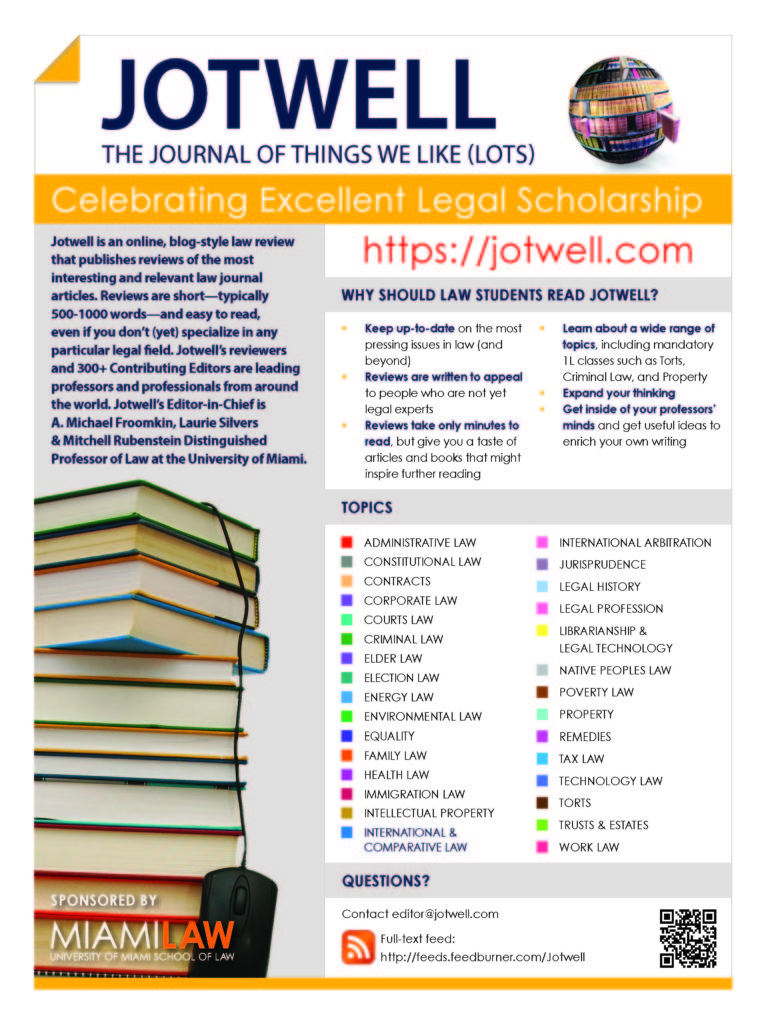
Click for full-size printable version
See you in two weeks, when we start the new, oddly virtual, academic year.
Aug 14, 2020 Daithí Mac SíthighTechnology Law
Laurence Diver,
Digisprudence: the design of legitimate code, 13
Law, Innovation & Technology __ (forthcoming, 2020), available at
LawArXiv.We often say that code is law, but what kind of law is it? Laurence Diver’s new article, Digisprudence: the design of legitimate code, introduces his ‘digisprudence’ theory, associating himself with the welcome emphasis upon design that is seen in particular in current work on privacy (e.g. Woodrow Hartzog’s Privacy’s Blueprint) and in Ian Kerr’s attention to the power of defaults, and doing so in light of a rich body of scholarship, from well beyond technology law, on law and legitimacy.
Code is not law, Diver says, with tongue slightly in cheek. It is more than law, constituting and regulating at the same time, rather than needing interpretation by addressees as law does. Yet it is also less than law, in the absence of, for instance, the possibility of disobedience. Drawing from ideas in the jurisprudential canon, including the morality of law and the more recent ‘legisprudence’ ideas of Luc Wintgens (on core principles for limiting subjective notions of freedom), Diver asks us to think of how ‘constitutional’ ideas such as legitimacy ought to be embedded in the software ‘legislature’, i.e. the contexts and environments for, and methodologies of, the production of software. He is rightly adamant that we must focus on production, arguing that code must be legitimate from the outset rather than often futilely retrofitted once it is in the wild. Continue reading "Code is More Than and Less Than Law"
Aug 13, 2020 Hoi KongInternational & Comparative Law
Duncan Ivison’s Can Liberal States Accommodate Indigenous Peoples? opens with the following questions: “Can liberal democracy accommodate the claims of Indigenous peoples? More precisely: can it do so justly?” (P. 12.) Ivison’s text is a rigorous and elegant response to these questions and essential reading for all who grapple with the circumstances of Indigenous peoples in contexts of “settler colonialism.” (P. 13.)
In the first chapter, Ivison identifies two key features of this form of colonialism. First, it involves “seizure and control of territory” that is justified by reference to “ideologies of civilizational and racial superiority and the denigration of Indigenous political institutions, philosophies, cultural practices and ways of life.” (P. 13.) Second, this process of “political domination and dispossession of territory” is “ongoing” and not a mere remnant of history. (Pp. 13-14.) Continue reading "Indigenous Peoples, Liberal Democracies and Public Reasoning"
Aug 12, 2020 Lee Anne FennellProperty
The lack of affordable housing in our nation’s most generative cities is an ongoing tragedy. The cause is hardly mysterious: incumbent residents—homeowners, sometimes joined by renters—artificially suppress housing supply by blocking development. The result reflects neither the verdict of free markets nor the outcome of democratic processes, but rather political and regulatory dynamics that are powerfully and systematically skewed against change.
In their new article, Professors Roderick Hills and David Schleicher dust off what might seem like just another wonky policy tool, the transferable development right (TDR), and repurpose it as a coalition-building device that can help unstack the political deck to facilitate development. Continue reading "Bundle and Conquer"